
Public and private workshops
When you do a workshop for a single company, the shared context among the audience means you can do a much better job. Sharing my learnings from 2 recent workshops I did.
As some of you might know, I’ve started conducting corporate workshops on using LLMs for data science. In this post, I want to talk about two such recent workshops that I did.
One of them was at VizChitra in early July. This was on “agentic dataviz” and about building agents that can consistently make great dataviz. I’ve written more about that here.
Agentic DataViz

That was the title of the workshop I conducted as part of the excellent VizChitra conference in Bangalore last week. The workshop had a capacity for 30 people, and the organisers ended up selling out all tickets.
A few days after this workshop, the good people at Zerodha invited me to do a similar workshop for their team. If you are not aware, being a brokerage, Zerodha puts out a whole lot of content. They have an entire “Zerodha Varsity” team aimed at educating investors (and others) on good financial practices. They also have a markets newsletter.
So that makes for a fairly significant content team at the company (~20 people attended my session). The objective of the workshop was to help them do better data analysis, and make better data visualisations to go as part of their overall content.
Like one of them told me before the workshop:
The broad goal is not merely to teach people how to operate a particular tool or produce a chart. It is to help them develop a sound way of thinking about data from the moment they encounter a dataset to the point at which they publish a conclusion or visualisation based on it.
The key difference between my VizChitra and Zerodha workshops was - the VizChitra workshop was all about “agentic workflows”. How can you set up an agent that can consistently make good charts for you? In the Zerodha case, that wasn’t the objective. The attendees all already used LLMs for data analysis and viz, and what they were looking for was how to use the tools better. It was clear that it would continue to be a human + tool effort.
So while I still got the Zerodha folks to build a dataviz skill, it was just one skill and not a suite of skills (like I did at VizChitra). And that eased up the process - since it was clear that a human would always be in the loop, the burden on the LLM was smaller, and it needed to be trained only for the most critical steps.
In a way, this is similar to how agentic workflows can lead to better data science models. There, when there is an LLM in the loop, the burden on the ML model becomes smaller!
How "agentic AI" makes for better data science

I’m generally suspicious of jargon, and so until now I’ve found the phrase “agentic AI” rather cringeworthy. However, at long last, I’ve figured that using it will give me more profit than loss, and so decided to “own it”.
Back to the workshop, the other big difference in doing an “open workshop” and a company-specific workshop is that the audience in the latter is necessarily less diverse, and that makes it far easier to teach. When you all work for a particular company, there is a shared context, which can be leveraged to create more effective examples and case studies.
At VizChitra, for example, I struggled with examples. The audience there was of varying experience levels (college students to my peers in data science) and varying backgrounds (data science, journalism, design, think tanks, etc.). I remember taking an example of Premier League football, and half the audience didn’t understand that.
At Zerodha, my job was much easier. I knew they all had the shared language of capital markets, and so all the examples were from there. Even better, since Zerodha as a company writes a lot, ALL my examples in the workshop (I usually do a bunch of “critique these graphs”) came from their own publications!
My other learning from both these workshops was that people use a variety of LLM tools, and you need to make sure your workshop is generic enough to cater to all of them. For example, those of us who have “grown up on Claude” use a lot of “skills” (I use a lot of skills in Codex as well), but skills are not always available on ChatGPT and Gemini. In both cases, AFTER having constructed the workshop, I had to figure out how to get the participants to use the learnings in their own LLMs.
The other change I made from the public workshop to the Zerodha one was to make the participants work in groups of 2-3. This was based on another quasi-workshop (at Vizchitra) that I had ATTENDED (by “Stud” Anand), where I found that the social element of working in groups (and the constant “discussions”) can aid in learning.
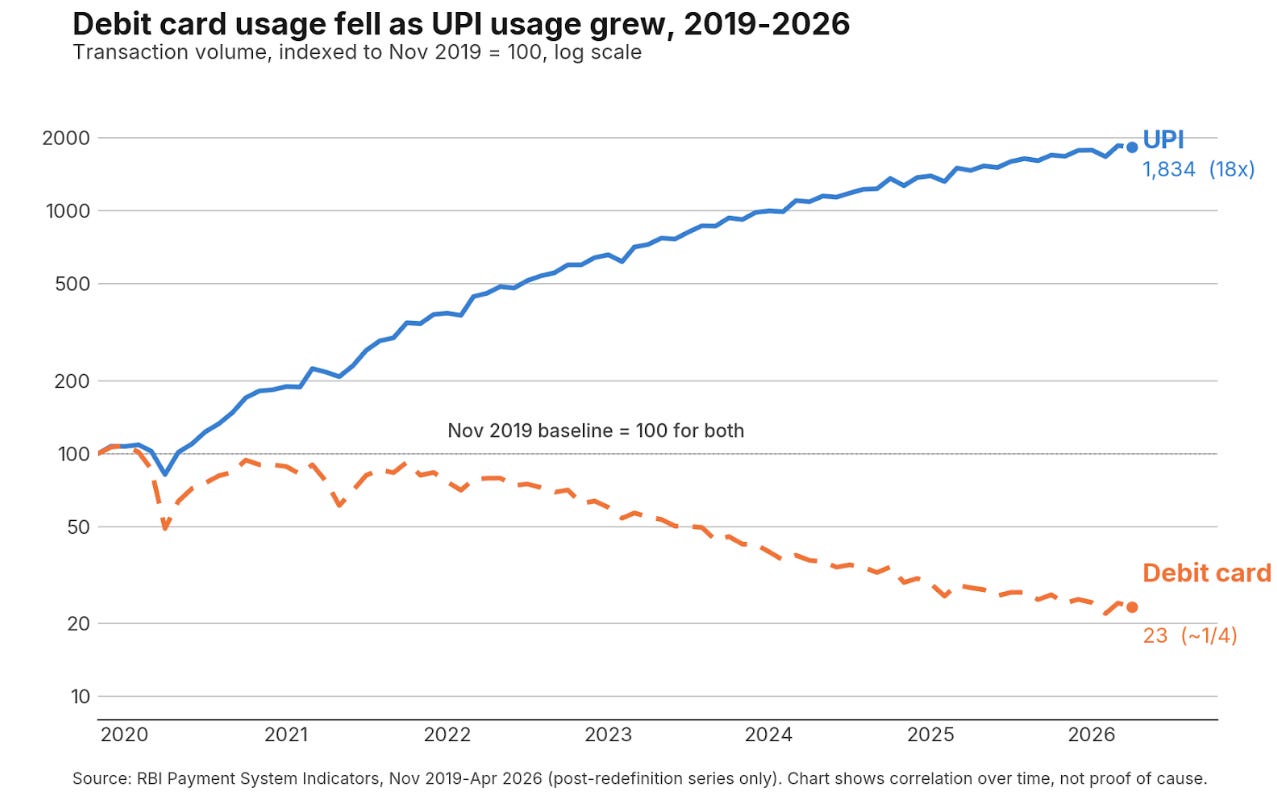
Also, I got the participants to all work on a common case study for the workshop (at VizChitra I’d got them to bring their own datasets - and that had meant less shared learning). Moving slightly away from their domain of capital markets, I gave them a comprehensive RBI dataset on payment system volumes and values (I had cleaned and organised the data before giving it to them), and got them to analyse if “UPI killed the debit card” (to be honest, Codex generated this question for me).
At the end of the workshop, this was my favourite output:
PS: Speaking of Zerodha, they also invited me to appear on their “In The Money” podcast to talk about all things AI.