

Dashboards will get leapfrogged
If you currently get your "insights" from excel / google sheets, you are already in the future. Conventional dashboarding tools such as Tableau / PowerBI will get leapfrogged.
Back in 2022, when I was leading what was internally known as the “BI Team” at Delhivery, I decided we needed to live up to our name and build some dashboards. I wrote “instilling a culture of management dashboards” in our annual operating plan, and made grand plans to hire a team to do this.
Those plans didn’t last long. On the one hand, we (a team skilled at both data science and business) found the process of building dashboards (on Quicksight - it came bundled with our AWS subscription) rather laborious - and back then there was no way then to make dashboards using code. On the other, the CEO said something to the effect of “we have grown this much without needing management dashboards. I’m sure we can continue to do without them”.
He was prescient. I don’t think dashboards in the conventional sense make that much sense any more. Like I wrote a couple of months ago (on my personal blog), with AI, once again, we can look at Excel / Google Sheets as an effective BI tool.

This morning I was talking to the head of data at a large American enterprise, explaining to him the work we had done at Babbage Insight. When I was talking to him about CXO insights he mentioned that the CXOs of his company “are backward and still get their data from Excel. We don’t even use dashboards”.
And that’s when I told him that it was no bad thing, as dashboards are something that will get leapfrogged - his company will go from providing CXOs numbers on Excel to providing CXOs (customised, AI-generated) analysis on Excel! They won’t need to make the transition to and from PowerBI or whatever their competitors are using.
Dashboards are useful tools that pretty much everyone loves to hate.
One clear illustration of why dashboards are not loved is the effort that goes into “driving adoption”. Like I never tire of telling people, when we started Babbage Insight, I interviewed ~100 CXOs (here is an “interim report”), asking them how they get insight from data. Less than 10 of them said they like looking at dashboards - the rest delegated this task to their teams.
Talking to heads of BI on the other hand, one problem that they consistently mentioned was “driving adoption of dashboards”. And the moment you need to “drive adoption” of any technology, you can be rest assured that this technology isn’t very user-friendly! If it is useful enough, people will adopt it themselves.
As an aside, you see a lot of takes on LinkedIn nowadays that “dashboards are dead. Conversational analytics is the answer”. However, those also suffer from the “driving adoption” problem. A few months ago, I curated the Winter Edition of the Fifth Elephant (dedicated to AI in data), where there were two talks on building “analytics copilots”. Both spoke about their efforts in “driving adoption” - if conversational analytics is supposed to be the magic bullet some people make it out to be, “driving adoption” should not require effort.
Back to “conventional” dashboards - there are several criticisms of those. In my opinion, a lot of them come out of not having a clear objective for building the dashboards - people see them as analytical tools (which they can never be) rather than reporting tools (which they are). And in trying to enable all kinds of analysis using the dashboards, they cause bloat, bringing in all kinds of metrics and forcing users to navigate through multiple dashboards, tabs and dropdowns.
There are other ways in which dashboards bloat - you added a widget because that was the most relevant explanation today; some team wanted an additional metric so you gave it to everyone;
All of these can be traced back to two primary issues:
dashboards being seen as analytical rather than reporting tools
one size fits all - attempting to serve the needs of several (kinds of) users using the same dashboard
As companies have continued to make these design mistakes and demand additional features in dashboards, the BI companies have responded, building in these features. Last year in the Bay Area, I spoke to a few former employees of ThoughtSpot, the OG of conversational analytics, and they spoke about how its growth was hampered by “lack of feature parity with Tableau”, and the company had to make significant investments in getting to such parity (looking back, this seems flawed - ThoughtSpot is an analysis tool while Tableau is a reporting tool; that users were asking for feature parity suggests something was off somewhere; That said, we in Babbage saw some of the same issues, though at a smaller scale).
Back to my conversation with the leader at the large American company, he wasn’t particularly impressed by my claim that “with AI, execs can continue to get their insights through Excel”. “But with Excel, you can only give some static cuts, what the analyst has in mind or is capable of quickly doing”, he countered. I made an attempt to tell him about how with AI, both the set of metrics and the supporing evidence involved can actually be customised by user (and what the metrics look like on a given day), but I realised it was a tough sell.
I still maintain that the current set of dashboarding tools (Tableau / PowerBI / … ) will get leapfrogged as AI allows true mass customisation (a term I first heard in my Marketing 101 course in 2004; a course I ended up getting a C in). Tools that allow for easy coding (and easy sharing of code - to train LLMs) will gain share. As will simpler “tools” such as spreadsheets.
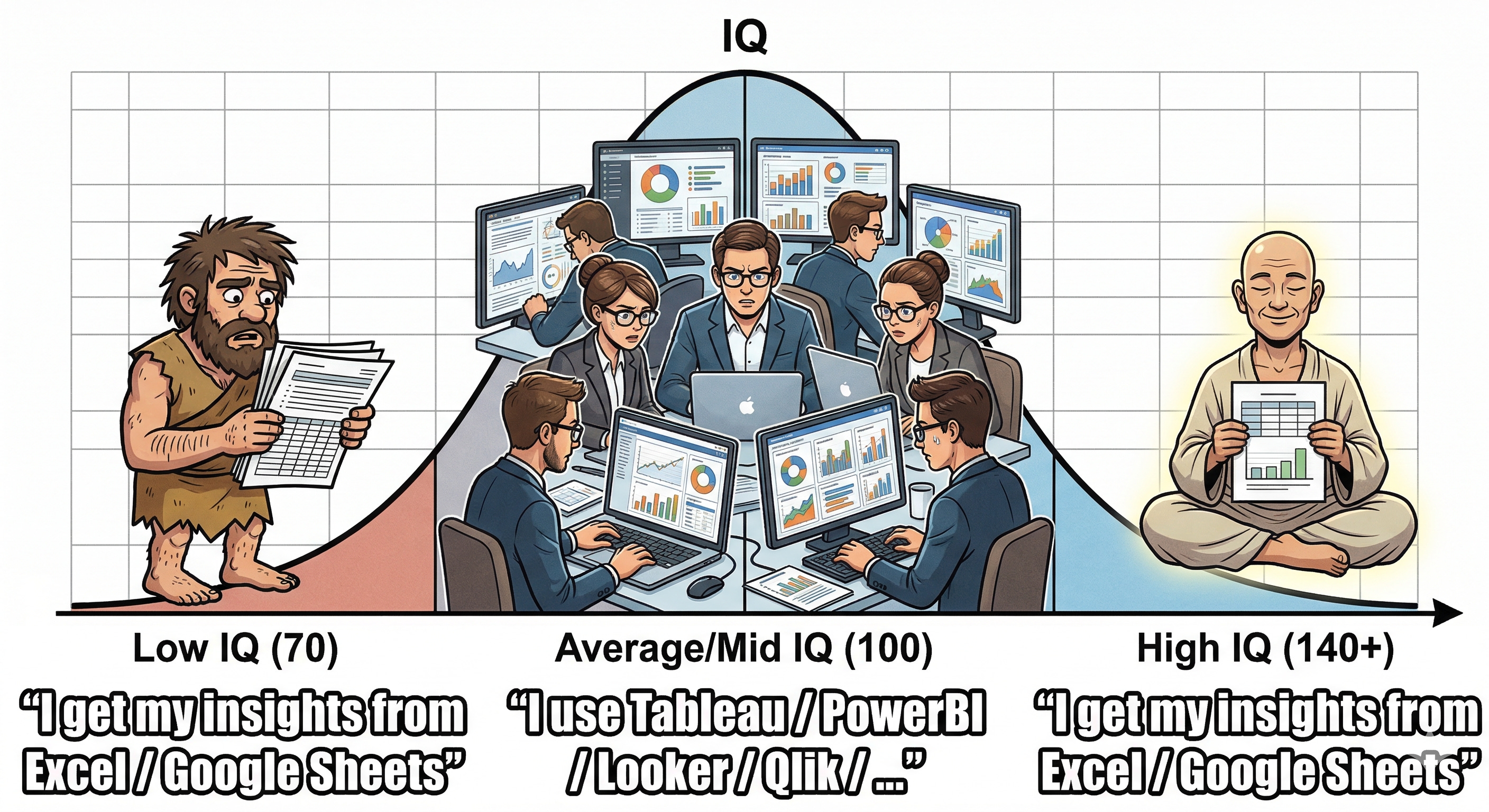
If you currently get your executive insights through spreadsheets, the “AI revolution” will mean that this will continue - just that the spreadsheets will become that much smarter!
PS: We are still in that part of the AI hype cycle that a lot of people still cannot appreciate what AI truly can and cannot do. So, despite having already started and shut a company in the space, I know we’re still in the early stages of the “AI x data wave”.
1. A dashboard is just a means to an end. I've never really heard the operating plan for a BI team be about 'culture of dashboards'. I mean if stakeholders require a lot of ad hoc analysis, you might not require dashboards for that.
2. Conventional dashboarding tools might get leapfrogged by new ones. But I don't see dashboards themselves going away, because in a large org everyone needs to have a shared sense of reality and dashboards serve that purpose.